Archive release
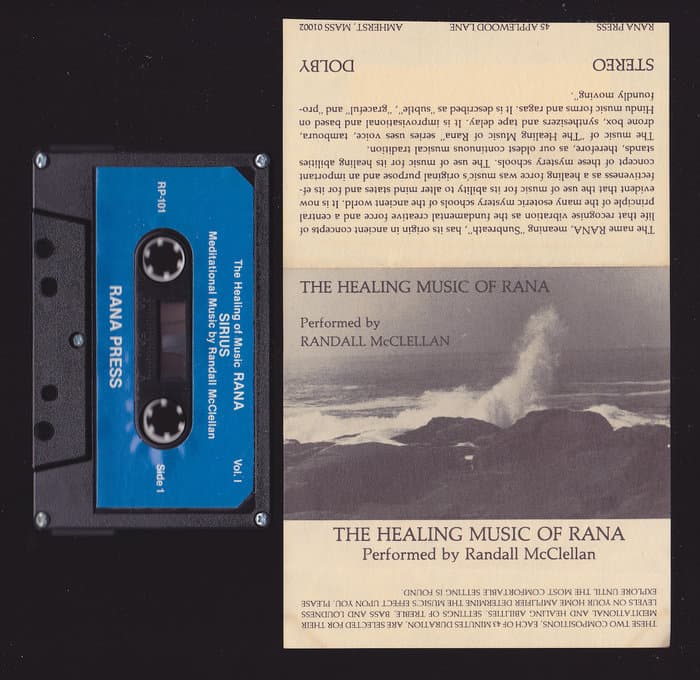
The Healing Music of Rana
<div> <div id="tracklist" class="section tracklist" data-toggle="tracklist">Tracklist <div> </div> <div class="section_content">A1 Solarwind Play 27:25 <br /> B1 Crystal Morning 24:16 </div> </div> <div class="section companies toggle_section toggle_section_remember" data-toggle-section-id="companies" id="companies">Companies, etc. <div class="section_content toggle_section_content"> <ul class="list_no_style"> <li>Copyright (c) – Randall McClellan</li> </ul> </div> </div> <div class="section credits toggle_section toggle_section_remember" data-toggle-section-id="credits" id="credits">Credits <div class="section_content toggle_section_content"> <ul class="list_no_style"> <li>Drone – Randall McClellan (tracks: A1,B1)</li> <li>Synthesizer – Randall McClellan (tracks: A1, B1)</li> <li>Tape – Randall McClellan (tracks: A1, B1)</li> <li>Voice – Randall McClellan (tracks: A1,B1)</li> </ul> </div> </div> <div class="section notes toggle_section toggle_section_remember" data-toggle-section-id="notes" id="notes">Notes <div class="section_content toggle_section_content">Cassette insert information reads: <br /> <br /> These two compositions are created to provide a healthful environment for relaxation and quiet contemplation. While settings of treble and bass on your home amplifier determine the music's effect, a low loudness level is most highly recommended.<br /> <br /> The name RANA, meaning 'Sunbreath', has it's origin in ancient philosophical concepts that recognized vibration as the fundamental creative force and central principle of the many esoteric mystery schools of the ancient world. It is now evident that the use of music for it's ability to alter mind states and for it's effectiveness as a therapeutic aid was music's original purpose and an important concept of these mystery schools. In the broadest sense, the practice of music for it's healing ability may well stand as our oldest continuous music tradition.<br /> <br /> The 'Music of Rana' Environmental Series uses synthesizers, drone box, tamboura, voice and tape delay to create an environment of continuously evolving multi-layered melody. Described as "subtle", "graceful", and "profoundly moving", it is improvisational and based on Hindu forms and ragas.<br /> <br /> These lengthy improvisations were created in live performance while I was seated on the floor behind a Moog Prodigy and Micromoog synthesizer - one above the other - to allow for simultaneous playing of the two keyboards. With the synthesizers, I used a microphone, small mixer, a specially designed drone box, and two reel-to-reel tape recorders placed side by side with a single audio tape passing from the first machine to the second . <br /> <br /> In performance, the sound is recorded on the first machine, played back several seconds later on the second machine, mixed then recorded on the first machine to create an environment of continuously evolving multi-level melody. Each repetition becomes progressively quieter and more distant as new melody is presented. <br /> <br /> Each improvisation lasts from twenty-five to forty-five minutes. An entire performance is up to three hours and is designed to provide an environment of meditative sound. <br /> <br /> Inspired by Indian ragas and forms, these performances were given in Northampton and Amherst Massachusetts and throughout New England, New York and Quebec Province between 1977 and 1983 in semi-darkened spaces that allowed listeners to relax on carpeting while being enveloped by sound. They gained in popularity and were soon attended by larger audiences. My final live performance took place at New York City's Alternative Museum in October, 1983. <br /> <br /> This music is based on principles outlined in my book, The Healing Forces of Music: History, Theory and Practice, written between 1979 and 1983 and first published in 1987. It is available from Amazon, including a Kindle edition. <br /> <br /> These two compositions are selected for their meditational and healing abilities. EQ settings of treble and bass levels determine the music's effect upon you. Please explore until the most comfortable settings are found. <br /> <br /> Released September 15, 1979 <br /> <br /> Randall McClellan - synthesizers, drone box, tape and voice delay <br /> Instrumentation - Moog Prodigy, Micromoog synthesizer<br /> <br /> Recorded in stereo<br /> <br /> All rights reserved ©1986 R. McClellan, ASCAP<br /> Sonic Arts Foundation 464 S. Roberts Rd. Bryn Mawr, PA 19010</div> </div> </div>
Tracklist
- A1Solarwind Play 27:25
- B1Crystal Morning 24:16
Credits & notes
Drone – Randall McClellan (tracks: A1,B1) Synthesizer – Randall McClellan (tracks: A1, B1) Tape – Randall McClellan (tracks: A1, B1) Voice – Randall McClellan (tracks: A1,B1) Copyright (c) – Randall McClellan Cassette insert information reads: These two compositions are created to provide a healthful environment for relaxation and quiet contemplation. While settings of treble and bass on your home amplifier determine the music's effect, a low loudness level is most highly recommended. The name RANA, meaning 'Sunbreath', has it's origin in ancient philosophical concepts that recognized vibration as the fundamental creative force and central principle of the many esoteric mystery schools of the ancient world. It is now evident that the use of music for it's ability to alter mind states and for it's effectiveness as a therapeutic aid was music's original purpose and an important concept of these mystery schools. In the broadest sense, the practice of music for it's healing ability may well stand as our oldest continuous music tradition. The 'Music of Rana' Environmental Series uses synthesizers, drone box, tamboura, voice and tape delay to create an environment of continuously evolving multi-layered melody. Described as "subtle", "graceful", and "profoundly moving", it is improvisational and based on Hindu forms and ragas. These lengthy improvisations were created in live performance while I was seated on the floor behind a Moog Prodigy and Micromoog synthesizer - one above the other - to allow for simultaneous playing of the two keyboards. With the synthesizers, I used a microphone, small mixer, a specially designed drone box, and two reel-to-reel tape recorders placed side by side with a single audio tape passing from the first machine to the second . In performance, the sound is recorded on the first machine, played back several seconds later on the second machine, mixed then recorded on the first machine to create an environment of continuously evolving multi-level melody. Each repetition becomes progressively quieter and more distant as new melody is presented. Each improvisation lasts from twenty-five to forty-five minutes. An entire performance is up to three hours and is designed to provide an environment of meditative sound. Inspired by Indian ragas and forms, these performances were given in Northampton and Amherst Massachusetts and throughout New England, New York and Quebec Province between 1977 and 1983 in semi-darkened spaces that allowed listeners to relax on carpeting while being enveloped by sound. They gained in popularity and were soon attended by larger audiences. My final live performance took place at New York City's Alternative Museum in October, 1983. This music is based on principles outlined in my book, The Healing Forces of Music: History, Theory and Practice, written between 1979 and 1983 and first published in 1987. It is available from Amazon, including a Kindle edition. These two compositions are selected for their meditational and healing abilities. EQ settings of treble and bass levels determine the music's effect upon you. Please explore until the most comfortable settings are found. Released September 15, 1979 Randall McClellan - synthesizers, drone box, tape and voice delay Instrumentation - Moog Prodigy, Micromoog synthesizer Recorded in stereo All rights reserved ©1986 R. McClellan, ASCAP Sonic Arts Foundation 464 S. Roberts Rd. Bryn Mawr, PA 19010
Reviews
No reviews yet — be the first.